
Coins.Game Review 2026
 Available in US
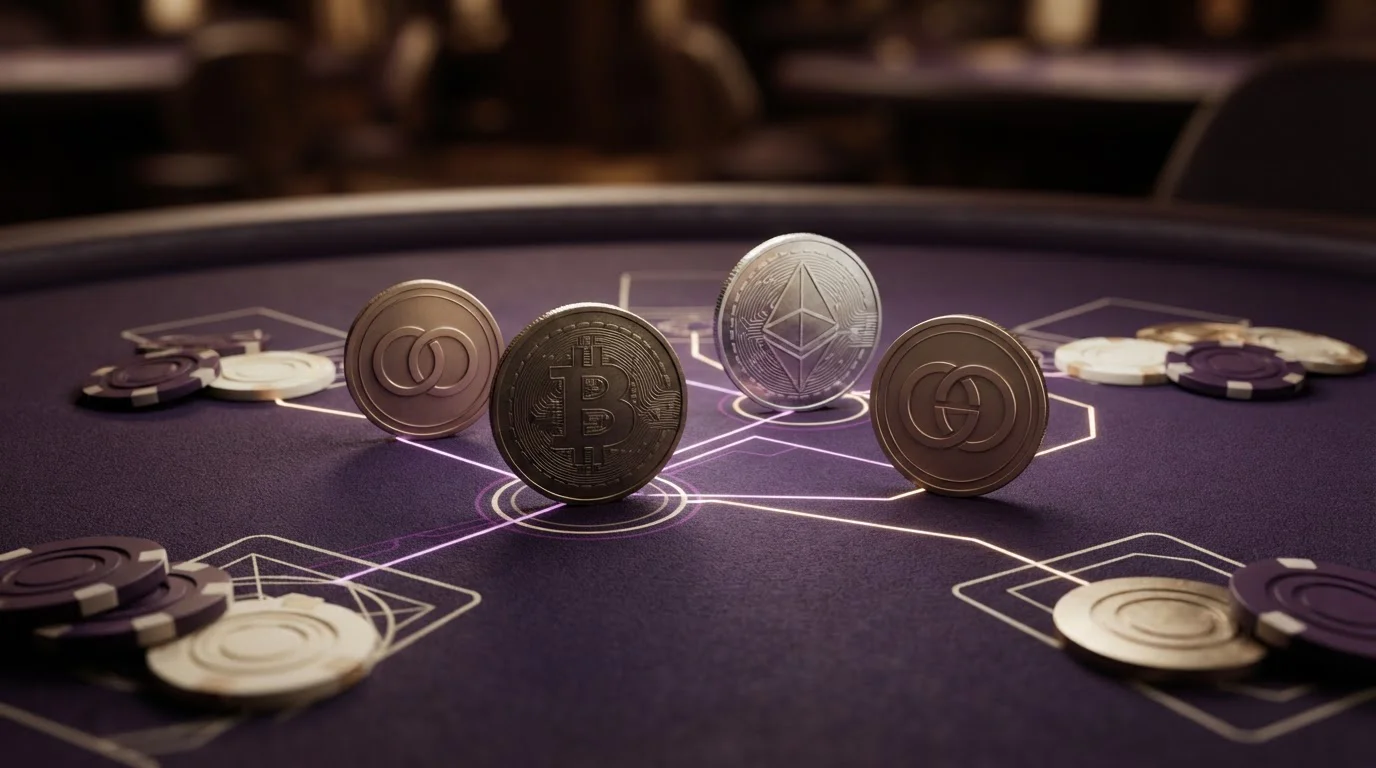
Coins.Game is a crypto-native casino launched in 2022, built around a broad multi-asset cashier, thousands of casino games, live tables and provably fair originals. The same setup that makes crypto central also puts more weight on network fees, verification and cashout conditions, so the practical experience depends on more than the game catalogue alone.
Table of Contents
- Coins.Game is built around crypto rather than adding it at the edge
- A wide coin list still leaves the network choice to the cashier
- The game catalogue mixes major studios with provably fair originals
- Estimate the theoretical cost of repeated play
- Bonus headlines change, but the underlying structure is consistent
- First-withdrawal verification can dominate the cashout timeline
- Browser-based mobile play and JET Rewards extend the core casino account
- Third-party ratings point in different directions
- Questions about Coins.Game
- Coins.Game combines broad crypto access with material cashout caveats
Coins.Game is built around crypto rather than adding it at the edge
The brand identity is the domain itself: coins.game. It combines a crypto-native casino with a sportsbook, although the focus here is the casino experience. The clearest differentiators are the breadth of supported assets, the large game library, provably fair originals and a loyalty layer built around JET Rewards.
- Established2022
- Crypto selection15+ assets
- Casino catalogueThousands of games
- Live casinoEvolution, Pragmatic Play and TVBet
- OriginalsProvably fair titles
- LoyaltyJET Rewards and VIP rakeback
- 2022Established year
- 15+Crypto assets described across coverage
Crypto is part of the operating model
BTC, ETH, LTC, USDT, USDC, DOGE, TRX, ADA, XRP, SOL, BNB and BCH appear in the supported set, while DOT and SHIB also appear in reviews. That breadth is useful only when the selected network is correct, because a coin ticker by itself does not tell you which chain a transfer will use.
The casino side spans several game types
The provider list includes Pragmatic Play, Evolution, NetEnt, Yggdrasil, BGaming, Microgaming, Red Tiger, Play’n GO, Endorphina, Betsoft, Platipus and TVBet. Exact catalogue totals differ across sources, so the defensible description is simply thousands of games rather than one fixed count.
Cashier friction matters as much as game choice
Crypto withdrawals are described without a platform fee, but network fees still apply. Fast cashout claims also sit beside a mandatory first-withdrawal verification process, which can change the timing of a real withdrawal substantially.
The practical question is not whether Coins.Game has enough features. It does. The useful comparison is between the breadth of those features and the conditions attached to moving money out, especially verification, network costs and offer terms.
A wide coin list still leaves the network choice to the cashier
Coins.Game supports a broad multi-crypto set and also has a fiat on-ramp through Moonpay, Skrill, Neteller, Paysafecard, Visa and Mastercard. The crypto side is multi-chain, but the public material does not map every supported asset to every available network. That makes the payment dialog the decisive place to check the exact route before sending funds.
The minimum deposit is a good example of why the live cashier matters. Published figures do not line up: different sources refer to a BTC-denominated minimum and to different fiat-equivalent thresholds connected with bonus activation. Treating any one of those as a universal deposit floor would oversimplify the cashier. The safer reading is that the applicable minimum depends on the asset, network and offer conditions shown during the transaction.
On withdrawals, coverage describes no platform crypto-withdrawal fee, while the blockchain network fee remains the player’s cost. That distinction matters. A fee charged by the casino and a fee paid to move an asset on-chain are not the same thing, and the latter can vary with the network. The dedicated Coins.Game payments guide separates those layers and shows where the cashier itself remains the source of the final amount.
| Payment factor | Coins.Game context | Practical consequence |
|---|---|---|
| Supported assets | 15+ crypto assets across major coins and stablecoins | Choose both the asset and the correct network before transfer. |
| Deposit threshold | Published figures differ by source and offer context | Use the current payment dialog instead of relying on one old minimum. |
| Withdrawal cost | No platform crypto-withdrawal fee is described; network fee remains | Final received value can still be lower because the blockchain transfer itself costs money. |
| Fiat access | Moonpay, Skrill, Neteller, Paysafecard, Visa and Mastercard appear as on-ramp methods | Fiat entry does not remove the need to understand the crypto side of withdrawal and network selection. |
Before sending crypto, compare the asset and network shown in your wallet with the route shown in the cashier. Blockchain transfers are generally irreversible, so a mismatch is not the kind of payment error that can be casually undone afterward.
The game catalogue mixes major studios with provably fair originals
The library is large, but the exact game count changes sharply across published sources, from the low thousands to much higher figures. The provider names are more stable than the headline total. Pragmatic Play, Evolution, NetEnt, Yggdrasil, BGaming, Microgaming, Red Tiger, Play’n GO, Endorphina, Betsoft, Platipus and TVBet all appear in the provider set.
Live casino is part of that mix, with Evolution, Pragmatic Play and TVBet among the named suppliers. Readers who mainly care about dealer tables can use the full Coins.Game games guide as the starting point and then move into the dedicated live-casino section from there.
The more distinctive crypto layer is the set of provably fair originals. Titles named in coverage include Crash, Dice, Mines, Plinko, Doge Racer, Ethereum Rush and Bitcoincash. Provably fair systems are about checking the relationship between cryptographic inputs and an outcome; they do not turn a casino game into a positive-expectation product, and they do not eliminate normal short-run variance.

Live suppliers
Evolution, Pragmatic Play and TVBet
Named originals
Crash, Dice, Mines, Plinko, Doge Racer, Ethereum Rush and Bitcoincash
Provider breadth
Major slot, live and crypto-oriented studios appear across the catalogue
Game total
Thousands of games; published totals differ too much to reduce to one stable figure
Outcome verification and bankroll risk are separate questions. A verifiable result can still come from a game with a house edge, and a long run of bets can create meaningful theoretical loss exposure even when each individual stake looks small.
Estimate the theoretical cost of repeated play
Coins.Game offers provably fair originals. Provably fair checks can help verify aspects of an outcome, but they do not remove house edge or variance. Use your own illustrative edge below to see how repeated bets change theoretical loss exposure.
Low theoretical exposure for this scenario. Short-run results can differ substantially from the theoretical expectation.
How this works
Total turnover = stake per bet × number of bets. Theoretical expected loss = total turnover × illustrative house edge ÷ 100. Bankroll exposure = theoretical expected loss ÷ entered bankroll × 100.
The estimate describes long-run mathematical exposure, not what any individual session will return. Provably fair verification does not remove house edge or variance.
18+. Gambling Therapy is an international support resource. Check your local helpline and gambling laws in your own country. Crypto values can move quickly, and blockchain transfers are generally irreversible.
Bonus headlines change, but the underlying structure is consistent
Coins.Game uses a multi-step welcome package built from deposit matches and free spins, plus a separate no-deposit free-spin offer. The presence of those components is consistent; the headline percentages, caps and spin totals are not. Published welcome figures vary widely, and the no-deposit offer is described with 100–150 spins rather than one stable number.
Wagering also depends on the specific offer. Sources attach requirements from roughly 20× to 60× across different bonus types. That spread is too wide to treat one multiplier as the permanent Coins.Game rule. The Coins.Game bonus guide therefore focuses on how to read the active terms rather than freezing one promotional headline into a universal figure.
- Identify which offer is actually attached to the deposit or free-spin promotion you are considering.
- Read the wagering basis carefully: a multiplier applied to bonus funds is different from one applied to deposit plus bonus.
- Check the active terms before placing qualifying bets, because different published offers carry different wagering levels.
- For no-deposit free spins, account for the reported requirement to make a deposit before winnings can be activated for withdrawal.
A separate cashback alternative is described as 10% daily cashback for seven days with 0× wagering. That is structurally different from a matched-deposit bonus because there is no wagering multiplier attached to the cashback figure in the cited review. The distinction is useful: bonus percentage alone says very little without the turnover requirement that sits behind it.
Consider a purely illustrative example unrelated to any Coins.Game offer. If a player receives $50 of bonus value with a 30× wagering requirement applied to that bonus, the required turnover would be $1,500 before other conditions are considered. The point of the arithmetic is not to predict value; it is to show why the multiplier can matter more than the headline percentage.
First-withdrawal verification can dominate the cashout timeline
Reviews consistently describe Coins.Game as requiring identity verification before the first withdrawal. The process can involve ID and proof of address, with a bank statement requested in some cases. That means a fast blockchain transfer is only one stage of a cashout: account review can become the slower part of the process.
Fast payout language appears in coverage, including “instant” and minute-level claims, but those claims are not guarantees. Reviews and complaint records describe verification delays ranging from about 48 hours to 15 days or more for some players, particularly when additional checks are triggered. AskGamblers also records complaints involving KYC delays, account closures and disputed funds. The dedicated Coins.Game account guide explains what information can be requested, while the withdrawal page separates the advertised transfer speed from verification-related delay.
What can keep a routine cashout simple
- Account details and identity documents are ready before the first withdrawal request.
- The withdrawal uses an asset and route supported in the cashier.
- The player treats network fees as separate from the casino’s own withdrawal-fee policy.
Where friction can build
- Extra identity or address checks can extend processing well beyond the marketed speed.
- Larger sums and VPN use are described as triggers for closer review.
- Complaint records include disputed delays and account-closure cases.
Do not treat “instant” as a guaranteed end-to-end withdrawal time. Blockchain settlement speed, internal review and identity checks are different stages, and the slowest stage determines how long the user actually waits.
Browser-based mobile play and JET Rewards extend the core casino account
Coins.Game is described as using a responsive HTML5 mobile site for iOS and Android browsers. For a crypto-first casino, that keeps the same basic payment and account model available on a phone rather than creating a separate mobile-only flow. The mobile guide focuses on what changes when the experience is compressed to a smaller screen, especially cashier checks and game controls.
Loyalty is built around JET Rewards and a VIP structure with rakeback. Coverage agrees on the existence of the reward currency, VIP progression and rakeback, while published tier names and exact percentages differ. One review describes a range from Bronze to Crypto King and rakeback from 2% to 20%; another uses a different Bronze/Silver/Gold/Platinum structure. The durable takeaway is the presence of tiered loyalty and rakeback rather than one universal tier chart.
The Coins.Game VIP guide separates those stable elements from the variable tier details. That matters because a loyalty program is easiest to evaluate when the benefit is tied to actual play volume and clearly stated terms, not just a tier name.
Mobile access follows the browser
The HTML5 interface is designed to work through mobile browsers on iOS and Android. For crypto transactions, the smaller screen makes address and network checking more important, not less.
JET Rewards adds a casino-specific loyalty layer
JET coins sit alongside VIP and rakeback benefits. Exact tiers vary in third-party descriptions, so the stable feature is the reward structure itself rather than a single published ladder.
Third-party ratings point in different directions
The trust picture is not uniform. AskGamblers lists an expert score of 6.9/10 and a player score of 6.5/10 across 31 reviews, alongside 20 complaints and themes that include KYC delays, account closures and disputed funds. Those figures sit in the middle rather than at either extreme.
Wizard of Odds is materially more critical, rating Coins.Game 2.4/5 with a D++ grade and highlighting terms it regards as problematic, including clauses connected with voided bets, withdrawal conditions and individual limits. Crypto-media editorial coverage is more positive, including an 8.2/10 review. Because those sources assess different things and reach sharply different results, collapsing them into one homemade trust score would hide useful disagreement.
Signals on the more positive side
- A large casino catalogue spans major software suppliers and live dealers.
- Crypto support covers 15+ assets and includes stablecoins as well as major coins.
- Provably fair originals add a verification mechanism for selected in-house-style games.
- Some editorial coverage scores the overall product substantially higher than complaint-focused sources do.
Signals that deserve closer attention
- Complaint records include delayed verification, account closures and disputed balances.
- Critical terms analysis flags clauses that can affect bets or withdrawals after a rules dispute.
- Advertised fast withdrawals do not describe every real-world verification case.
- Bonus terms vary enough that an old headline can diverge from the active offer.
| Trust signal | Published assessment | What it captures |
|---|---|---|
| AskGamblers expert view | 6.9/10 | Expert review plus complaint activity |
| AskGamblers player view | 6.5/10 across 31 reviews | User-reported experience |
| Wizard of Odds | 2.4/5, D++ | Terms, complaints and operator practices |
| Crypto-media editorial review | 8.2/10 | Product-focused editorial assessment |
For practical due diligence, the disagreement itself is informative. Product breadth and crypto features can be strong at the same time that complaint handling, identity checks or contractual terms create friction. Readers who want the separate dispute-resolution details can follow the Coins.Game license page.
Questions about Coins.Game
Is Coins.Game a crypto casino?
Yes. Coins.Game is a crypto-native casino with a broad multi-asset payment setup and a large catalogue of casino games.
Which cryptocurrencies does Coins.Game support?
Coverage lists 15+ assets, including BTC, ETH, LTC, USDT, USDC, DOGE, TRX, ADA, XRP, SOL, BNB and BCH, with DOT and SHIB also appearing in reviews.
Does Coins.Game require verification before withdrawal?
Yes. Reviews consistently describe identity verification as required before the first withdrawal, typically involving ID and proof of address, with a bank statement requested in some cases.
Are Coins.Game withdrawals instant?
Fast withdrawal claims exist, but they are not a guarantee. Verification and larger cashouts can extend the process substantially.
Does Coins.Game have provably fair games?
Yes. Its originals include provably fair titles such as Crash, Dice, Mines and Plinko, alongside other crypto-themed originals.
Read next
- How Coins.Game payments and network fees work
- Explore the Coins.Game game catalogue
- Read the Coins.Game bonus terms in context
- Review Coins.Game license and dispute details
Coins.Game combines broad crypto access with material cashout caveats
Coins.Game has substantial casino depth: a 15+ asset crypto setup, thousands of games, major live-casino suppliers, provably fair originals, browser-based mobile access and a JET-based loyalty system. The trade-off is concentrated around money movement and terms. Deposit minimums and bonus headlines vary across published material, first-withdrawal verification can extend cashout timing, and third-party trust assessments range from positive editorial scores to sharply more critical complaint and terms reviews. A careful user should therefore evaluate the cashier, active bonus terms and account-verification requirements as closely as the game catalogue itself.
Published by the Coins.game team.