Coins.Game
Coins.Game Payments 2026
 Available in US
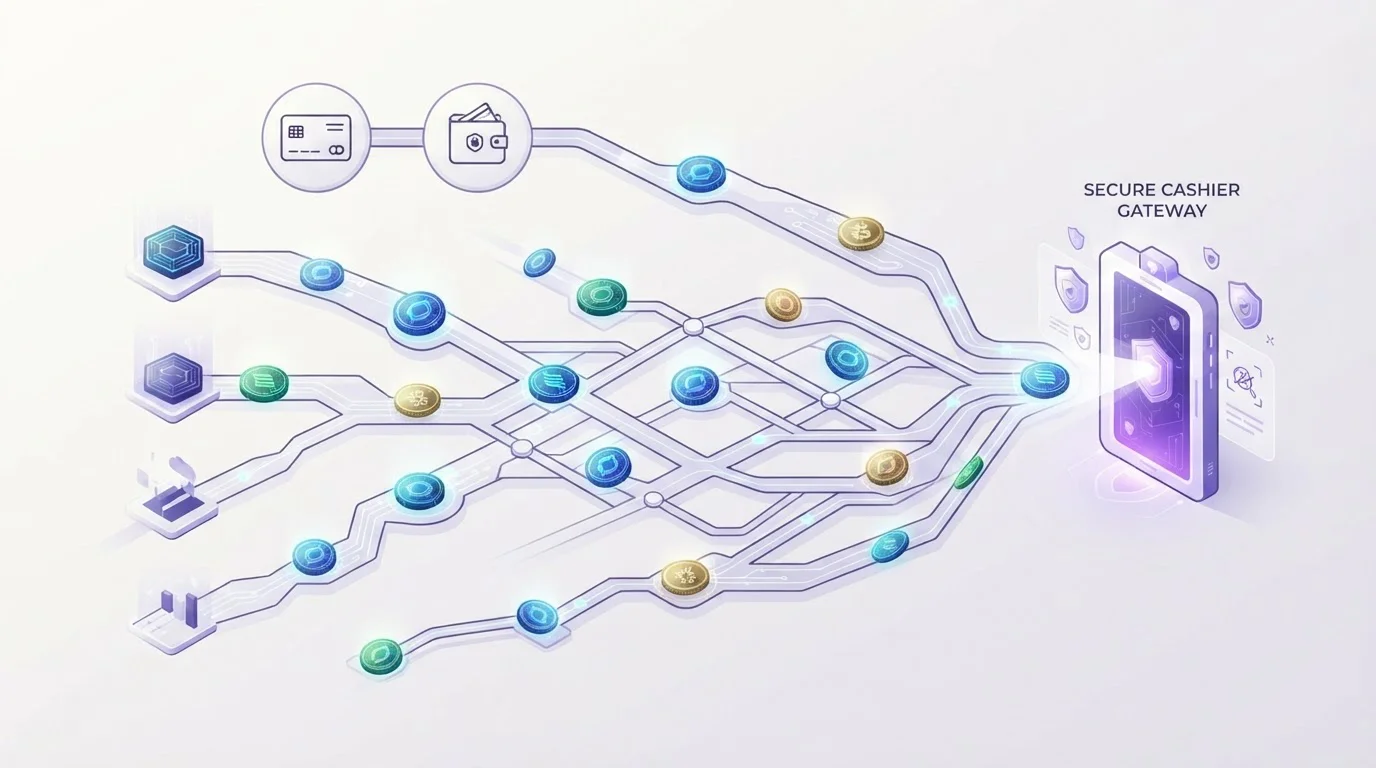
Coins.Game is built around multi-asset crypto payments, with coverage describing 15+ supported assets and a separate fiat on-ramp through Moonpay, Skrill, Neteller, Paysafecard, Visa and Mastercard. The cashier is broad, but its practical cost and speed depend on details that vary by coin, network and account status rather than on one universal deposit or withdrawal figure.
On this page
- Supported assets and funding routes
- Coins, thresholds, speed and fees
- Why the network affects cost
- Why the deposit minimum is not one number
- Withdrawal speed and verification friction
- Payment-friction matrix
- A safer crypto payment routine
- Questions about Coins.Game payments
- What the cashier demands from the user
Table of Contents
- A broad crypto list is the starting point, not the whole payment decision
- The useful differences are in withdrawal floors and network costs
- Coins.Game separates its own withdrawal fee from the blockchain fee
- The minimum deposit depends on more than one published number
- Fast cashout claims sit beside a mandatory first-withdrawal identity check
- The main payment friction comes from four different layers
- A disciplined payment routine reduces address, network and timing mistakes
- Questions about Coins.Game payments
- Coins.Game payments depend on network discipline and verification timing
A broad crypto list is the starting point, not the whole payment decision
Coins.Game supports more than 15 crypto assets. The repeatedly named set includes BTC, ETH, LTC, USDT, USDC, DOGE, TRX, ADA, XRP, SOL, BNB and BCH, while DOT and SHIB also appear in reviews.
- Crypto range15+ assets
- Stablecoins namedUSDT and USDC
- Fiat on-rampMoonpay, Skrill, Neteller, Paysafecard, Visa, Mastercard
- Crypto withdrawal feeNo platform fee reported; network fee remains
Major coins and stablecoins sit in the same cashier
The supported set spans large-cap assets such as BTC and ETH, payment-oriented coins such as LTC and XRP, stablecoins USDT and USDC, and several newer networks or ecosystem assets. That breadth can reduce the need to convert into one specific coin before depositing.
Fiat funding adds an entry route without changing the crypto risk model
Moonpay, Skrill, Neteller, Paysafecard, Visa and Mastercard appear as fiat on-ramp options. Their role is to get value into the crypto-casino payment flow; once crypto is involved, price movement and irreversible blockchain transfers still matter.
Network choice remains the hidden variable
Coins.Game is described as multi-chain, but the public material does not provide a complete coin-by-coin network map. The live payment dialog therefore matters because the same ticker can behave differently depending on the network used for that transaction.
The dedicated Coins.Game withdrawal guide goes deeper on cashout timing, account checks and monthly-limit risk. For deposits, the main discipline is to treat the cashier as the source of the exact address, network and threshold for the transaction you are making.
The useful differences are in withdrawal floors and network costs
Coins.Game supports a broad crypto set, but three cashier details deserve separate treatment: the network selected for the transfer, the asset-specific withdrawal minimum and the blockchain fee. Published deposit floors are not consistent enough to reduce to one number, so the live cashier remains the practical reference for the amount required before sending funds.
| Coin | Network | Min Dep | Min WD | Speed | Fee |
|---|---|---|---|---|---|
| BTC | Selected in cashier | No single published floor: 0.001 BTC-equivalent and $10–$20 bonus-linked figures conflict. Use the live cashier. | 0.002 BTC cited | Fast path is advertised as instant–5 min. First-withdrawal KYC can extend processing to 48 hours or, in some reported cases, 15+ days. | No platform fee reported; one review gives a BTC network-fee example around EUR 2.5. |
| ETH | Selected in cashier | Asset-specific | Blockchain fee applies. | ||
| LTC | Selected in cashier | Asset-specific | No platform fee reported; one review gives an LTC network-fee example around EUR 0.04. | ||
| USDT | Multi-chain; route shown in cashier | Asset-specific | Network-dependent; cited examples range from 1 to 50 USDT depending on route. | ||
| USDC | Multi-chain; route shown in cashier | Asset-specific | Network-dependent; cited examples range from 1 to 50 USDC depending on route. | ||
| DOGE, TRX, ADA, XRP, SOL, BNB, BCH | Selected in cashier | Asset-specific | No platform fee reported; blockchain fee depends on the selected asset and route. |
Two checks prevent most avoidable payment errors: match the network shown by Coins.Game to the sending wallet, then review the exact minimum and fee before confirming the transfer. The ticker alone is not enough when an asset can move across more than one chain.
Coins.Game separates its own withdrawal fee from the blockchain fee
Coins.Game does not add a platform fee to crypto withdrawals according to the reviewed payment information. That does not make withdrawals cost-free. The blockchain fee remains, and the amount can change with the asset and network used for the transfer.
Published fee examples put BTC around EUR 2.5 and LTC around EUR 0.04, while stablecoin withdrawal costs can vary widely by network. These figures illustrate how the cost model works rather than serving as live quotes, because network conditions and route selection can change.
Casino withdrawal fee
No platform crypto-withdrawal fee is reported in the reviewed coverage
Network fee
Paid to move the asset on-chain and varies by route
Stablecoin behavior
USDT and USDC fees are described as network-dependent
Final amount
Check the payment dialog before confirming the withdrawal
Costs you can identify before sending
- The asset selected in the cashier.
- The network offered for that asset.
- The withdrawal amount before network cost.
- The destination wallet and whether it supports the same route.
Costs that can move between transactions
- Network congestion can change the on-chain fee.
- Stablecoins can have materially different costs on different networks.
- Crypto prices can move between deposit, play and withdrawal.
- Conversion through a fiat on-ramp can add a separate provider layer.
The minimum deposit depends on more than one published number
Published minimum-deposit figures conflict. One source gives 0.001 BTC or an equivalent amount, while other figures refer to $10 or $20 thresholds in bonus-related contexts. Those are not interchangeable because a cashier minimum, a bonus-activation threshold and a fiat equivalent can describe different things.
The practical rule is to use the live payment dialog for the exact asset and network you plan to use, then read any bonus conditions separately. A bonus threshold can be higher than the basic cashier requirement, and treating the two as one number can create an avoidable mismatch between the amount deposited and the offer expected.
Cashier minimum
This is the smallest amount the payment flow will accept for a specific asset and route. It can change when the coin or network changes.
Bonus threshold
This is the amount required to activate a particular promotion. It belongs to the offer terms rather than to the basic mechanics of sending funds.
Fiat equivalent
A dollar or euro figure attached to a crypto deposit can move as the underlying asset price changes, which is another reason not to freeze one universal amount into a static rule.
Do not size a crypto transfer from an old bonus headline alone. Confirm the current cashier minimum first, then confirm the offer requirement separately if a promotion is involved.
Fast cashout claims sit beside a mandatory first-withdrawal identity check
Coins.Game is marketed in reviews with withdrawal speeds ranging from instant to around five minutes. Those claims describe the fast path, not a guaranteed end-to-end result. Identity verification before the first withdrawal is a separate stage, and reviews and complaint records describe delays from roughly 48 hours to 15 days or more when checks become intensive.
The withdrawal minimum is described as EUR 10 or 0.002 BTC in one review, while other coverage says minimums vary by asset. Monthly-limit reporting is also not fully uniform: EUR 10,000 per month is the dominant figure across several sources, while one outlier gives $50,000. The useful conclusion is that both the floor and the cap need to be checked for the specific account and asset instead of being treated as one universal cashier rule.
The Coins.Game account guide explains the ID and proof-of-address stage in more detail. The separate withdrawal page follows what changes when a routine request becomes a longer verification or limit case.
| Cashout factor | Coins.Game evidence | What changes for the user |
|---|---|---|
| Advertised speed | Instant to about five minutes appears in coverage | Treat it as the fast path rather than a guarantee |
| First withdrawal | Identity verification is required | Processing can pause while documents are reviewed |
| Longer checks | 48 hours to 15+ days appears in reviews and complaints | Large or scrutinized withdrawals can take much longer |
| Minimum withdrawal | EUR 10 or 0.002 BTC appears in one review; asset-specific minima also appear | Check the selected coin in the cashier |
| Monthly cap | EUR 10,000 dominates the reporting; one source cites $50,000 | Do not assume one universal cap without checking current account terms |
The main payment friction comes from four different layers
A crypto cashier can look simple because the user selects an asset and copies an address. Coins.Game adds enough asset choice that four layers need to be separated: platform fees, network costs, internal processing and account verification.
Mostly visible before the transaction
- Asset and network offered by the live payment dialog.
- Minimum shown for the selected deposit or withdrawal route.
- Destination address and any memo or tag required by the route.
- The absence of a separate platform crypto-withdrawal fee in published coverage.
Can extend the real cost or timing
- Network fees change with the selected blockchain route.
- Verification can interrupt the advertised fast-withdrawal path.
- Large amounts can interact with monthly cashout limits.
- Crypto price movement can change fiat-equivalent value between funding and withdrawal.
The cleanest comparison is not “crypto versus free.” It is platform fee plus network fee plus any conversion cost, measured against the amount you actually intend to move. That separates the casino’s fee policy from costs created by the blockchain or on-ramp provider.
A disciplined payment routine reduces address, network and timing mistakes
Crypto transactions are generally irreversible. A mistake that would be fixable with a card chargeback may not be reversible once an on-chain transfer is final, so routine checks matter more than speed.
- Select the asset in the Coins.Game cashier. Do not begin from the wallet side and assume the casino supports the route you already have in mind.
- Match the network exactly. The public material does not provide a complete per-asset network map, so use the route shown in the live payment dialog.
- Check the minimum for that transaction. Published deposit figures conflict, and withdrawal minimums can be asset-specific.
- Copy the address and any memo carefully. Recheck the first and last characters before sending. A small test transfer can reduce the size of an address or network mistake.
- Separate the blockchain fee from the casino fee. Coins.Game is described without a platform crypto-withdrawal fee, while the network fee remains.
- Plan for verification before the first withdrawal. Fast-cashout marketing does not remove the account checks that can extend processing.
Questions about Coins.Game payments
Which cryptocurrencies can I use at Coins.Game?
Coins.Game supports 15+ crypto assets, including BTC, ETH, LTC, USDT, USDC, DOGE, TRX, ADA, XRP, SOL, BNB and BCH, with DOT and SHIB also appearing in reviews.
What is the minimum deposit at Coins.Game?
Published minimum-deposit figures conflict, so one universal amount would be misleading. Use the live payment dialog for the selected asset, network and offer.
Does Coins.Game charge a crypto withdrawal fee?
Coins.Game does not add a platform fee to crypto withdrawals according to the reviewed payment information, while the blockchain network fee still applies and can vary by asset and network.
How fast are Coins.Game withdrawals?
Fast withdrawal claims range from instant to about five minutes, but identity checks and larger withdrawals can extend processing substantially, including multi-day cases.
Can I fund Coins.Game without already holding crypto?
Yes. Fiat on-ramp options include Moonpay, Skrill, Neteller, Paysafecard, Visa and Mastercard.
Read next
- Coins.Game withdrawal timing and limits
- Coins.Game account and verification checks
- How deposit amounts interact with bonus terms
- Coins.Game review and feature overview
Coins.Game payments depend on network discipline and verification timing
The cashier offers genuine breadth: 15+ crypto assets, stablecoins and several fiat on-ramp methods. The friction is concentrated in details that a single headline cannot capture. Deposit minimums differ across published figures, withdrawal floors can be asset-specific, network fees remain even when the casino does not add a platform fee, and first-withdrawal verification can turn an advertised fast cashout into a much longer process. The practical advantage comes from checking the live route and terms before every material transfer rather than relying on a remembered number.
Written by the editors at Coins.game.